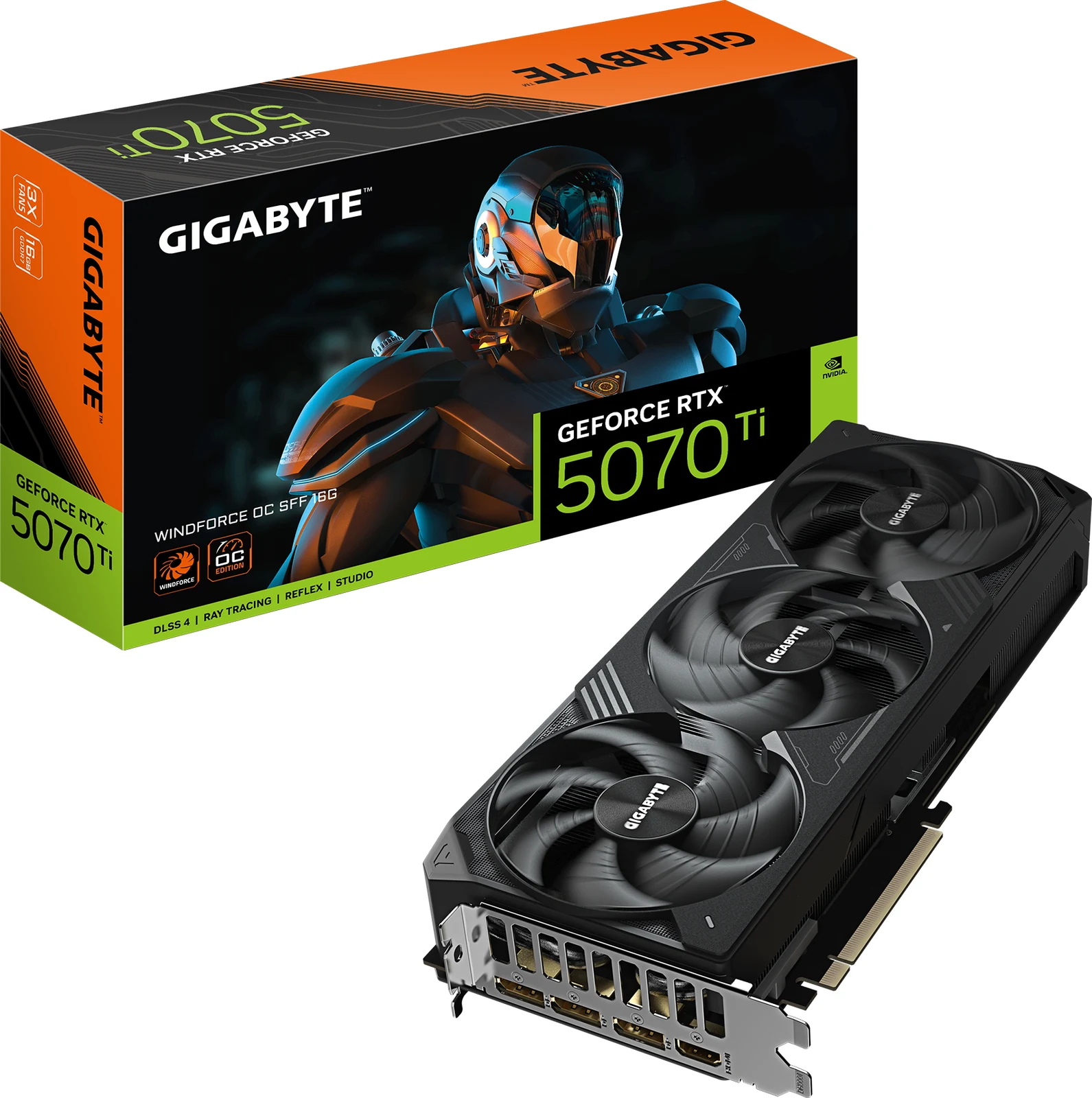
GIGABYTE GeForce RTX 5070 Ti WINDFORCE OC SFF 16G
Some links are Amazon affiliate links: we earn a commission if you buy, at no extra cost to you, and it never changes what we recommend. How we make money
Graphics Cards · GIGABYTE
Our verdict
Our pick for a 4K or ultrawide monitor: 16 GB of GDDR7 and DLSS 4 with Multi Frame Generation, in a version short enough for compact cases. It needs a 750 W power supply; on a 1440p screen, the RTX 5070 covers it for less.
Our analysis
On paper the ASUS Prime RX 9070 XT is its closest match: both carry 16 GB, both ask for a 750 W supply, and they are rated at 300 W and 304 W. What differs is the memory type, GDDR7 here against GDDR6, the upscaler, DLSS 4 against FSR 4, and the length, 304 mm against 312 mm. If you stream with NVENC or play games built around DLSS, this one; if not, compare the two prices on the day you buy.
What stands out
- 16 GB of GDDR7. The memory amount of the RX 9070 XT, on the newer memory type, and 4 GB more than the RTX 5070.
- DLSS 4 with Multi Frame Generation. It generates extra frames between the ones the card renders, in the games that support it.
- SFF version at 304 mm. GIGABYTE builds this WINDFORCE version for small cases that do not take longer cards.
- Three DisplayPort 2.1b outputs plus HDMI 2.1b. Room for a monitor and a TV without adapters.
Where it falls short
- It asks for a 750 W power supply and is rated at 300 W, so the 550 W supply of a 1080p build will not cover it.
- On a 1080p or 1440p screen, a large part of what you pay for goes unused; it makes sense with a 4K or ultrawide monitor.
Look elsewhere if
- You play at 1440p: the ASUS Prime RTX 5070 is also SFF-Ready and asks for a 750 W supply, with 12 GB of VRAM as the trade-off. If you want 16 GB on a lighter power budget, the ASUS Dual RTX 5060 Ti 16GB needs only 550 W.
It closes the list in our guide to the best graphics cards, where we lay out which resolution each card is aimed at.
View on Amazon (paid link)
Tools for this part
- How big a power supply does it need? Open the PSU calculator with it
- Will it fit your case? Check it to the millimeter
Specs
- VRAM: 16 GB
- Memory type: GDDR7
- Power draw: 300 W
- Boost clock: 2497 MHz
- PSU the brand recommends: 750 W
- Upscaling: DLSS 4
- Length: 304 mm
- Power connector: 1 × 16-pin
- Ray tracing: Yes (4th gen)
- Video outputs: 3 × DisplayPort 2.1b, HDMI 2.1b
We cover it in these guides
- RTX 5070 vs RX 9070 XT: Which One to Buy in 2026
- Modern Warfare 4 PC Requirements and TPM 2.0 Check
- The 6 Best Graphics Cards for Gaming in 2026 (1080p to 4K)
Other graphics cards we compared
- ASUS Prime Radeon RX 9070 XT OC Edition 16GB GDDR6
- ASUS Prime GeForce RTX 5070 12GB GDDR7 (SFF Ready)
- ASUS Dual GeForce RTX 5060 Ti 16GB GDDR7 OC Edition
- ASRock Radeon RX 9060 XT Steel Legend 16GB
- PNY GeForce RTX 5050 Dual Fan 8GB GDDR6
- GIGABYTE GeForce RTX 5060 WINDFORCE OC 8G